
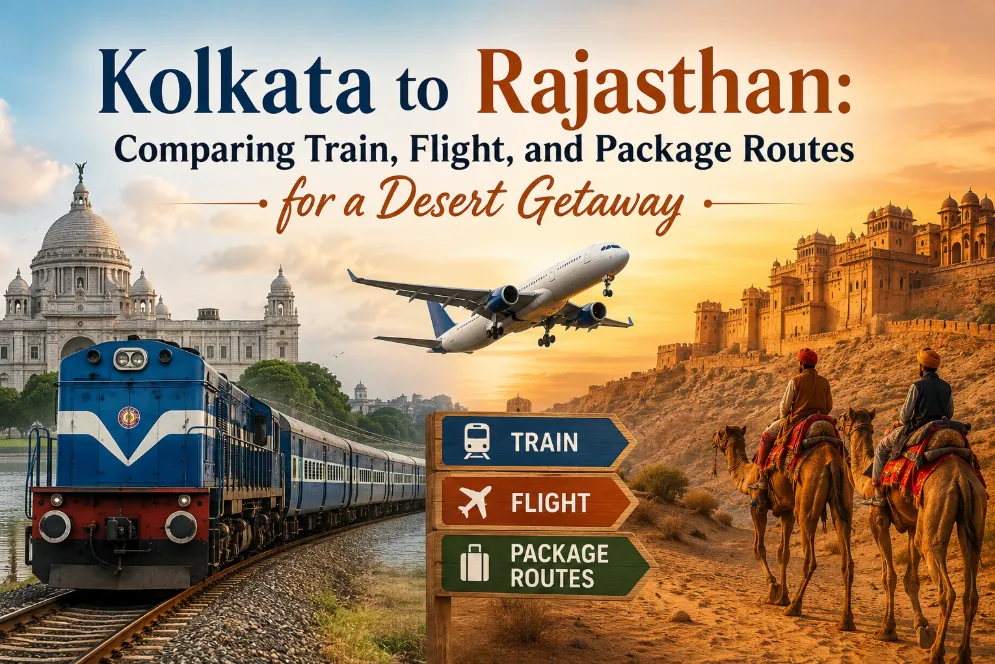
Anyone in Kolkata searching for Rajasthan tour packages from Kolkata runs into the same practical question before they’ve even started thinking about forts or desert camps: how do you actually get there? Rajasthan sits on the opposite side of the country from Bengal, and unlike a Delhi-to-Jaipur hop that barely counts as a journey, Kolkata to Rajasthan is a genuine cross-country trip, with train rides stretching past a full day and flights requiring some thought about which city to fly into. None of that makes the trip difficult, but it does mean the route you choose shapes the entire trip more than most travelers expect, and it’s worth understanding the real options before booking anything.
The Train Journey: Long, but Genuinely Part of the Experience
Kolkata has decent rail connectivity to Rajasthan’s major cities, running out of Howrah and Sealdah stations, though “decent” comes with a significant time commitment. The most direct route runs from Sealdah to Jaipur on the Sealdah-Ajmer Superfast Express, covering roughly 1,500 kilometers in a little over 24 hours. That’s a full day and change on a train, which sounds punishing on paper but is a genuinely common way for budget-conscious and time-rich travelers to make this trip, particularly if an overnight sleeper berth is booked rather than treating the ride as something to endure rather than plan for properly.
Jodhpur and Udaipur are considerably further out from Kolkata than Jaipur is, and the rail journeys reflect that. A direct train from Howrah to Jodhpur runs several days a week and takes around 30 hours, while the direct Kolkata-Udaipur route stretches even longer, with the more direct of the two available trains taking roughly a day and ten hours. These aren’t journeys to book casually — they require genuinely planning around, ideally with an overnight or two-night sleeper booking, snacks and entertainment sorted in advance, and realistic expectations about arriving tired rather than refreshed. For travelers who enjoy train travel as part of the adventure rather than a necessary evil, though, watching the landscape shift from Bengal’s green plains to the arid stretches of Rajasthan over a day and a half has its own kind of value that a three-hour flight simply can’t replicate.
The Flight Option: Faster, but Not Equally Fast to Every City
Flying is the far more time-efficient option, but the connectivity isn’t identical across Rajasthan’s major cities, and that difference matters when deciding where to start your trip. Jaipur has the strongest direct flight connectivity from Kolkata, with a nonstop flight taking roughly three hours, making it comfortably the easiest and fastest entry point into the state from Bengal. Jodhpur and Udaipur, by contrast, typically don’t have reliable nonstop service from Kolkata, meaning most travelers flying to either city will connect through Delhi or Mumbai, adding a layover and stretching total travel time to somewhere in the four-to-six-hour range depending on the connection.
This connectivity gap is exactly why Jaipur functions as the practical gateway city for most Rajasthan trips originating from Kolkata, regardless of which cities end up on the final itinerary. Flying into Jaipur directly, then working the rest of the state’s classic loop — Jodhpur, Jaisalmer, Udaipur — by road or rail from there, is almost always more efficient than trying to fly directly into a second city and hoping for a convenient connection.
Weighing Cost Against Comfort
Cost differences between the train and flight options are significant enough to shape the decision for a lot of travelers, especially families or groups traveling together. Long-distance sleeper train fares to Rajasthan from Kolkata remain relatively inexpensive even in reserved classes, which is part of why the rail route stays popular despite the time investment — for a family of four, the fare difference between train and flight can be substantial enough to fund an extra night in a heritage hotel or an additional desert safari once you arrive. Flights, particularly booked close to travel dates or during peak season, cost considerably more, but they return an entire day or more of your trip that would otherwise be spent in transit.
The honest answer to which option is “better” depends heavily on how much total time you have. A traveler with ten days or more can comfortably absorb a 24-hour train journey each way and still have a full week in Rajasthan itself, and may genuinely enjoy the journey as part of the trip. A traveler working with five or six days total should almost certainly fly, since losing two full days to train travel out of a short trip cuts meaningfully into the time actually spent seeing forts, deserts, and lakes rather than train compartments.
How This Shapes the Rest of Your Itinerary
Once you’ve settled on Jaipur as the practical entry point, the rest of the trip follows a logic that applies regardless of whether you arrived by train or plane. From Jaipur, the standard route runs west to Jodhpur, further out to Jaisalmer for the desert leg, then back through Jodhpur and south to Udaipur, which works well as a closing city thanks to its own airport and reasonable connections back toward eastern India, generally routed through Delhi or Mumbai rather than a nonstop Kolkata service. This means most complete trips built around Rajasthan tour packages from Kolkata follow a similar shape: fly or take the train into Jaipur, cover the classic loop over the following week or so, and exit either back through Jaipur or via Udaipur’s airport, depending on how the return connections line up.
Travelers who’d rather not manage the train timings, connection layovers, and city-to-city logistics themselves are increasingly the ones driving demand for structured packages that handle this end-to-end — booking the right entry city, sequencing the internal travel sensibly, and building in enough buffer time so a delayed train or a missed connection doesn’t unravel the whole trip. That coordination is genuinely one of the more useful things a well-planned package handles quietly in the background, well before you ever set foot in a fort or a desert camp.
What About Bringing the Whole Family, or Traveling in a Group
Route choice shifts again once you’re planning for a larger group rather than a solo trip or a couple. Families traveling with young children or older parents often find the flight-into-Jaipur option worth the extra cost even when budget is a real constraint, simply because a 24-hour train journey is a very different proposition with a restless toddler or a grandparent who needs regular breaks than it is for an adult traveling alone or with a partner. Groups of friends or larger family gatherings, on the other hand, sometimes lean toward the train specifically because it becomes part of the trip’s social experience — a shared sleeper compartment, meals brought along or bought at station platforms, and a full day of conversation before the sightseeing even begins.
There’s also a middle option worth considering for larger groups: flying one direction and training the other. Flying into Jaipur to start the trip fresh and energized, then taking an overnight train back from Udaipur or Jodhpur at the end of the loop, spreads out the time cost of rail travel while still capturing some of the experience, and it avoids asking tired travelers to face a long train ride on both the outbound and return legs of the same trip.
A Few Practical Notes for Kolkata Travelers Specifically
If you do choose the train route for at least one leg, book well in advance, particularly during the cooler travel season between October and March when both Bengali and broader Indian travelers are booking the same routes for the same reasons. Sleeper or AC-class berths sell out faster than the general public tends to expect for a journey this long, and last-minute bookings often mean settling for a less convenient departure time or a longer layover-heavy alternative.
It’s also worth building at least one buffer day into your schedule immediately after a long train journey rather than diving straight into sightseeing on arrival. A 24 to 30-hour train ride, even a comfortable one, leaves most travelers wanting a slow first afternoon rather than an immediate fort visit, and planning for that upfront tends to make the rest of the trip feel less rushed. Whether you fly in for speed or take the train for the experience and the savings, getting the entry city and the first day’s pacing right sets the tone for everything that follows.
