
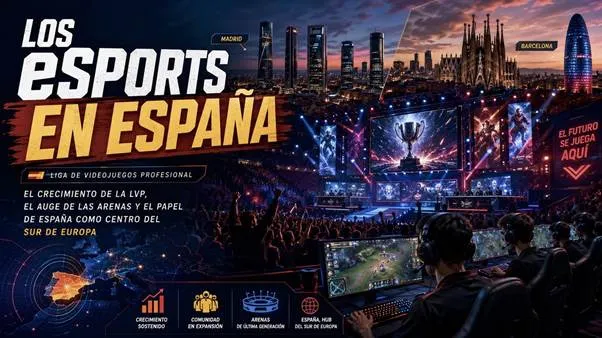
Over the past decade, Spain has quietly transformed from a country of enthusiastic bedroom gamers into one of the most important competitive gaming markets in Southern Europe. What was once a fragmented collection of online tournaments and community LAN parties is now a structured, professionalized industry complete with sold-out arenas, television-grade broadcasts, national leagues, and household-name teams. At the center of that transformation sits the Liga de Videojuegos Profesional (LVP), the Barcelona-based operator that did more than perhaps any other single organization to turn Spanish esports into a spectator sport worth taking seriously.
The story is not just about companies and contracts, though. It is about people: an increasingly passionate fanbase and a growing network of resources for Spanish players who follow every match, debate roster changes, and pack venues to watch their favorite squads compete in person. That grassroots energy is the fuel that made everything else possible, and it explains why esports in Spain grew as quickly as it did.
The Rise of the LVP
The LVP was founded in 2011 with a straightforward but ambitious goal: to treat video game competition as a genuine professional sport rather than a hobby. In its early years the league operated on modest resources, but the concept resonated. In 2013 it staged the first edition of Gamergy, a live gaming festival that would go on to become one of the anchors of the Spanish esports calendar. The real inflection point came in 2016, when the media giant Mediapro acquired a majority stake in Fandroid, the company behind the LVP. Mediapro’s audiovisual muscle brought professional production values, television-style studios, and the financial stability needed to scale. By 2019 Mediapro had taken full ownership in a deal reportedly worth around 22 million euros, a figure that signaled just how seriously the media industry had begun to view competitive gaming.
That backing changed everything. Suddenly, matches were being produced from broadcast-quality sets in Barcelona, commentated by professional casters, and streamed live to tens of thousands of viewers on platforms like Twitch. The amateur ceiling had been lifted, and a clear pathway now existed for talented players to turn skill into a career.
Building the Superliga
The crown jewel of the LVP’s operation became the Superliga, its top-tier League of Legends competition and the most important esports league in Spain. Known at various points by its sponsor names — Superliga Orange in the late 2010s, and later Superliga Domino’s — it established the pyramid structure familiar to traditional sport, with a second division feeding talent into the elite tier. Teams like Giants, Movistar Riders, MAD Lions, and KOI became genuine brands, some of them eventually merging and going on to compete at the continental level in the League of Legends EMEA Championship (LEC).
Crucially, the Superliga was never an isolated product. The LVP also produced eLaLiga, the official EA Sports FC (formerly FIFA) competition run in partnership with LaLiga, and helped launch Rising, the country’s flagship VALORANT circuit, backed by brands such as MediaMarkt and Intel. This diversification across multiple game titles meant Spanish esports were not dependent on the health of any single game, which broadened their audience and their commercial appeal.
The Arena Era: Esports Goes Physical
For a long time, esports were something you watched on a screen. Spain was among the countries that helped change that by moving competition into physical venues. League finals began to be staged as live events in front of thousands of fans, and dedicated spaces started to appear. Madrid opened La Arena eSports, a pioneering public venue combining free gaming areas, virtual reality zones, and a streaming production set. Purpose-built cyber arenas such as the COLIZEUM venues began popping up in cities, giving local players professional-grade facilities to practice and compete in.
Major finals and international events found homes in large multi-purpose venues like the Madrid Arena, Palacio Vistalegre, and the Caja Mágica, while Barcelona’s Fira and the Mediapro studios hosted everything from community LAN tournaments to headline broadcasts. The effect was profound: esports gained the visual language of traditional sport — crowds, chants, stage lighting, live reveals — and that spectacle drew in casual audiences who might never have watched a stream at home.
A Southern European Hub
Spain’s influence did not stop at its borders. The LVP became the largest esports organization in the Spanish language, exporting its model across Latin America with national leagues in Argentina, Chile, Colombia, Mexico, and beyond, all feeding into the continental Liga Latinoamérica. It even operated circuits further afield, including a spell running the UK’s national League of Legends competition. Within Southern Europe specifically, the Iberian Cup brought together the best teams from Spain, Portugal, and Italy, cementing the country as a regional gravity well for competitive gaming.
Today, Spain continues to attract marquee international events. Barcelona has hosted large-scale tournaments across titles like Counter-Strike, VALORANT, and EA Sports FC, and remains a regular stop on the global esports circuit. That international pull is the clearest evidence of how far the scene has come.
Growing Pains and What Comes Next
No growth story is a straight line, and Spanish esports have recently entered a more turbulent phase of maturation. In September 2025, Fandroid, the company behind the LVP, announced significant workforce reductions in response to falling revenues and softening audience numbers — a reminder that even established operators are not immune to the wider correction the global esports industry has faced. Shortly afterward, organizing responsibility for the League of Legends Superliga passed to new operators, marking the end of an era in which the LVP single-handedly defined the domestic scene.
Rather than a collapse, this looks more like the industry finding a sustainable footing after years of rapid, sometimes overheated expansion. The foundations the LVP built — a professionalized talent pipeline, a broadcast culture, physical venues, and above all a devoted fanbase — have not disappeared. They have simply been handed to a new generation of organizers and companies eager to carry the momentum forward.
The Road Ahead
Spain’s journey from casual gaming culture to esports powerhouse is a case study in what happens when grassroots passion meets professional investment and physical spectacle. The LVP lit the fuse and Mediapro provided the resources, but it was the fans filling arenas and following every roster move who made the scene real. As new operators take the reins and international events keep choosing Spanish cities, the country looks set to remain one of the beating hearts of competitive gaming in Southern Europe for years to come.
