
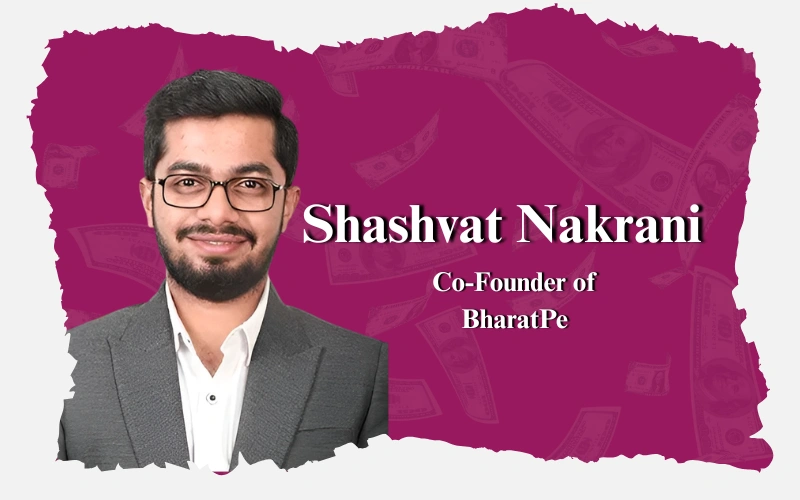
It’s 2018, and a 19-year-old textile engineering student from Bhavnagar, Gujarat walks into his college dorm with a problem nobody was solving. Not the sexy kind of problem that gets VC funding on day one, mind you. But a real, gritty, everyday problem that affects 50+ million small businesses across India.
Within three years, Shashvat Nakrani turned that “boring” problem into a ₹23,000 crore empire. Today, at just 26 years old, he’s worth ₹1,300 crore and has become one of India’s most talked-about young entrepreneurs. But here’s the thing—his story isn’t about getting rich quick or disrupting an industry for the sake of disruption. It’s about solving real problems for real people, and doing it better than anyone else.
The Shashvat Nakrani Story at a Glance
| Metric | Details |
|---|---|
| Current Age | 26 years old |
| Birth Year | 1999 |
| Birthplace | Bhavnagar, Gujarat, India |
| Current Net Worth | ₹1,300 crore (2024-2025) |
| Education | B.Tech Textile Engineering, IIT Delhi |
| Co-founder of | BharatPe (2018) |
| BharatPe Valuation | $2.9 billion (2021) |
| Unicorn Status Achieved | 2021 (at age 22) |
| Forbes Recognition | Forbes 30 Under 30 Asia (2021) |
| Number of Investments | 13+ startups |
| BharatPe Key Product | Interoperable Zero MDR UPI QR Code |
| Stock-based Compensation (FY22) | ₹70 crore (218% YoY increase) |
| Countries with BharatPe Operations | Expanding across India in 100+ cities |
Who Is Shashvat Nakrani? The Real Story Beyond the Headlines
You know what’s funny? Most startup success stories follow a predictable script. College kid gets magical idea. Gets funded by famous VCs. Launches product. Everyone loves it. IPO. Billionaire status. The end.
Shashvat Nakrani’s story is decidedly not that story.
Shashvat Nakrani was born in 1999 and is an Indian entrepreneur best known as the co-founder of BharatPe, one of the leading fintech companies in India, making him one of the youngest entrepreneurs to reach unicorn status with his startup. But numbers don’t capture the full picture.
Growing up in Bhavnagar, a tier-2 city in Gujarat, Shashvat Nakrani wasn’t surrounded by startup culture or Silicon Valley dreams. He came from a small town where his family strongly valued education, and he developed an early interest in technology, problem-solving, and innovation. His parents weren’t tech entrepreneurs themselves—they were just people who believed in the power of learning and doing.
When he enrolled at IIT Delhi for a B.Tech program in Textile Engineering, Nakrani maintained a strong interest in technology and its role in driving change, especially in finance. Here’s where it gets interesting: He was studying textile engineering, not computer science or electrical engineering. This actually becomes important later, because it means he came to fintech with fresh eyes, unburdened by conventional wisdom about how payment systems “should” work.
The Moment Everything Changed
In his third year at IIT Delhi, Nakrani identified a critical gap in the digital payment ecosystem. While various apps facilitated UPI transactions, merchants struggled to manage payments across multiple platforms.
Let me paint the picture: You’re a small shopkeeper in Delhi. A customer walks in and says, “Can I pay by UPI?” You say yes. They ask which app? You say, “WhatsApp Pay? Google Pay? Paytm? PhonePe?” The customer gets confused. Your checkout process gets messy. You’re losing sales because of friction in the payment process.
This friction was costing millions of small businesses real money every single day. And Shashvat Nakrani noticed something that the big boys had missed: Nakrani envisioned a simplified payment system that used the interoperability feature of UPI, ultimately giving rise to BharatPe.
Bold move alert: He decided to drop out of IIT Delhi to pursue this vision.
Now, I know what you’re thinking. “But wait, everyone says staying in school is important!” And yes, it is—for most people. But for Shashvat Nakrani, the opportunity cost of staying in school was higher than the opportunity cost of leaving. That’s the kind of math that separates entrepreneurs from aspiring entrepreneurs.
How BharatPe Was Born: The Genesis of a Fintech Revolution
Let me introduce you to the partnership that emerged between Shashvat Nakrani and Bhavik Koladiya, which Ashneer Grover later joined to co-found BharatPe in 2018. This founding trio understood something fundamental about Indian commerce that most fintech companies missed entirely.
See, the Indian payment ecosystem in 2018 wasn’t built for small merchants. Banks demanded collateral. Payment gateways charged transaction fees that ate into thin margins. And most “digital payment” solutions were just apps that required internet, data plans, and a comfort level with technology that many shopkeepers simply didn’t have.
BharatPe’s revolutionary insight? Use QR codes. They’re simple, free to print, and work offline. Pair that with UPI’s interoperability, and you suddenly have something magical.
The Magic of Zero MDR and Interoperability
Here’s where Shashvat Nakrani and the BharatPe team got genuinely clever. BharatPe became the first fintech company to launch interoperable zero MDR UPI QR, allowing merchants to streamline transactions and accept payments from all major UPI apps.
Let me break down why this matters:
MDR stands for “Merchant Discount Rate.” It’s basically a fee that merchants pay every time a customer swipes a card or makes a digital payment. In India, these fees were killing small business margins. BharatPe said, “What if we made it zero?” Most people said that was impossible. BharatPe did it anyway.
Interoperability is equally genius. Instead of making merchants choose one payment app, BharatPe’s QR code works with all major UPI apps. Google Pay, WhatsApp Pay, PhonePe, Paytm—all of them. One QR code. Zero friction. Zero fees.
This is the kind of innovation that doesn’t make headlines because it’s not shiny or sexy. It’s not AI-powered or blockchain-based. But it solves a real, expensive, everyday problem for 50 million small businesses. And that’s worth more than a thousand “innovative” ideas.
The BharatPe Business Model: Disrupting Payment Infrastructure
By 2021, BharatPe achieved the coveted unicorn status, which meant the company was valued at over $1 billion. This milestone was a testament to the strength of their product, market strategy, and the dedication of their team. Three years from inception to unicorn. That’s faster than most college students finish their degrees.
But the real genius of Shashvat Nakrani’s leadership at BharatPe wasn’t just the QR code innovation. It was understanding that payment infrastructure is just the beginning. The real value lies in what comes next.
Beyond Payments: Building Financial Inclusion
BharatPe’s merchant lending program was one of the standout innovations. Small businesses often struggle to get loans due to a lack of proper financial infrastructure. BharatPe addressed this by offering instant loans based on transaction history, making it easier for merchants to access working capital.
Think about this for a moment: You’re a shopkeeper. Your business is doing well. Your daily sales are visible to the bank through BharatPe’s system. You need working capital for inventory. What do you normally do? You ask friends, family, or local moneylenders who charge 30-40% interest rates. Now, with BharatPe, you can get a loan instantly, based on real transaction data, at reasonable rates. You’re no longer trapped by your circumstances.
This is financial inclusion in action. And it’s not charity—it’s smart business. Every loan creates stickiness. Every loan customer becomes a more loyal user of the platform. It’s a virtuous cycle.
BharatPe’s product offerings now include: BharatPe UPI QR Code (a free QR code for merchants to accept payments via UPI), BharatPe Loans (instant working capital loans for small merchants), BharatPe Card (a business credit card linked to the merchant’s BharatPe account), and BharatPe Cashbacks (loyalty programs that reward merchants with cashback on transactions).
Notice the pattern? Every product solves a real problem and creates more value for merchants. It’s not feature bloat. It’s strategic ecosystem building.
Shashvat Nakrani’s Technical Leadership: The Unsung Side of Genius
Here’s something you’ll rarely read about Shashvat Nakrani because most media focuses on the business side: He’s technically brilliant.
While his co-founder Ashneer Grover handled the business and fundraising side, Shashvat focused on building the technology behind the platform. He made sure BharatPe was easy to use, secure, and able to grow with user demand. His mix of tech skills and business understanding helped the company stand out.
Let me translate what that means: Building a payment system that processes millions of transactions is hard. It needs to be secure (because we’re dealing with money). It needs to be fast (because merchants can’t wait). It needs to be reliable (because failures cost money). And it needs to be scalable (because you want to grow from 1,000 merchants to 10 million merchants).
Shashvat led the development of a simple interface that made it easy for shopkeepers to accept digital payments. He also helped build the lending system that gave small businesses access to working capital based on their payment history.
This is the unsexy, behind-the-scenes work that separates mediocre fintech companies from genuinely transformative ones. Building the UI that a shopkeeper finds intuitive isn’t about fancy design. It’s about understanding your user’s mental model and making the system conform to their thinking, not the other way around.
From Dropout to Billionaire: Shashvat Nakrani’s Net Worth Journey
Let’s talk money. Because numbers tell stories too.
In 2021, Shashvat Nakrani, a co-founder of BharatPe, made history as the youngest person to feature on the IIFL Wealth Hurun India Rich List. At just 23 years old, he joined the ranks of 13 other self-made billionaires born in the 1990s.
At 23. Twenty-three years old. Most people at that age are just starting their internships.
According to the 2024 Hurun India Rich List, Shashvat Nakrani’s net worth stands at an impressive ₹1,300 crore at just 26 years old. But here’s what makes this even more interesting:
Nakrani’s reported salary for FY22 was ₹29.8 lakh. However, this figure excludes stock-based payments, which amounted to ₹70 crore in FY22, reflecting a 218% year-on-year increase, according to financial disclosures filed with the Registrar of Companies (RoC).
The Angel Investor Side: Shashvat Nakrani’s Portfolio Strategy
By 2024-2025, Shashvat Nakrani had transitioned from purely building one company to investing in others. This is the mark of a mature entrepreneur—someone who understands that their value isn’t just in running one business, but in identifying and supporting other talented founders.
Shashvat Nakrani’s portfolio is diversified across multiple sectors, with significant investments in: Fintech (companies like Liquide and BharatPe), Health & Wellness (investment in Kindlife), Technology (investments like Fego.ai and White Inc.), Media (his investment in NewsReach), and Real Estate (Crib).
Shashvat Nakrani’s investment philosophy focuses on technology-driven innovation, financial inclusion, and the empowerment of small businesses. His key strategies include: Focus on Disruption (investing in startups that deliver disruptive solutions in fintech and technology), Tech and AI-Centric Solutions (emphasizing AI-powered platforms), Support for Early-Stage Companies (investing in seed and pre-seed stage companies), and Diversification (covering high-growth sectors).
The Controversial Moments: Navigating the Rough Waters
No entrepreneurial journey is smooth. BharatPe encountered significant storms that included major legal disputes and executive changes during its operation. Through steady leadership, Nakrani steered the company toward success and established himself as a key figure in India’s startup industry.
The most publicized controversy involved Ashneer Grover, the co-founder who originally brought Shashvat Nakrani into the project. There were disputes about management, board decisions, and the direction of the company. These were messy, public, and at times, ugly.
But here’s what matters: Nakrani’s journey from being a college dropout to a young billionaire is a great example of determination and innovation. He didn’t let the controversies derail the company or abandon his vision. He worked through the challenges and kept building.
That’s called resilience. It’s not glamorous, but it’s essential.
Recognition and Awards: The Forbes 30 Under 30 Moment
In 2021, Shashvat Nakrani was named in Forbes 30 Under 30 Asia, a prestigious list of young innovators in business. His recognition was not just a personal achievement but also a mark of the success of BharatPe and the fintech ecosystem in India.
Forbes 30 Under 30 is nice, but let’s be honest—it’s not the award that made him successful. He was already successful. The award is just external validation. And while it’s great to have your work recognized, it’s worth noting that Shashvat Nakrani achieved everything before getting the award. Not after.
Beyond Business: Shashvat Nakrani’s Social Commitments
Apart from his entrepreneurial pursuits, Shashvat is deeply passionate about social causes. He actively supports financial inclusion and believes that empowering small businesses can lead to overall economic development. Shashvat is also involved in education initiatives aimed at promoting technology education among young people in India, particularly in small towns and rural areas.
This is important because it shows that Shashvat Nakrani’s mission isn’t just about making himself rich. He’s genuinely interested in lifting others up. And given that he came from a small town himself, this commitment feels authentic rather than performative.
He’s invested his time and resources in technology education for young people in places like his hometown—the kind of investment that doesn’t show up on a profit and loss statement but changes lives.
Conclusion: The Narrative We’re Still Writing
When you look at Shashvat Nakrani’s journey from a teenager in Bhavnagar to a billionaire at 26, it’s tempting to think it’s just luck or genius or being at the right place at the right time.
But that misses the point entirely.
The real story is about choosing to see a problem that everyone else walked past. It’s about having the audacity to build a solution. It’s about maintaining technical excellence while scaling a business. It’s about navigating failure and controversy without losing your principles. It’s about using your success not just to enrich yourself, but to empower others.
Read More:
Frequently Asked Questions
1. Who is Shashvat Nakrani?
Shashvat Nakrani is an Indian fintech entrepreneur and co-founder of BharatPe. Shashvat Nakrani is widely known for simplifying digital payments for small merchants across India.
2. Why is Shashvat Nakrani famous?
Shashvat Nakrani became famous for building BharatPe at a young age and helping revolutionize India’s UPI-based payment ecosystem. Shashvat Nakrani is also recognized as one of the youngest entrepreneurs to achieve billionaire status in India.
3. What is the role of Shashvat Nakrani in BharatPe?
Shashvat Nakrani is the co-founder of BharatPe and played a key role in developing its merchant-focused payment solutions. The vision of Shashvat Nakrani helped BharatPe scale rapidly across India.
4. Did Shashvat Nakrani drop out of IIT Delhi?
Yes, Shashvat Nakrani was studying at Indian Institute of Technology Delhi but chose to drop out to fully focus on building his startup. This decision by Shashvat Nakrani proved to be a turning point in his career.
5. What are the major achievements of Shashvat Nakrani?
Some key achievements of Shashvat Nakrani include:
- Co-founding BharatPe
- Scaling a successful fintech startup
- Enabling digital payments for millions of merchants
- Becoming one of India’s youngest billionaires
6. What is the net worth of Shashvat Nakrani?
The net worth of Shashvat Nakrani varies based on market valuations, but Shashvat Nakrani has been listed among India’s youngest billionaires due to his stake in BharatPe.
7. What can we learn from Shashvat Nakrani?
From Shashvat Nakrani, we learn:
- Focus on solving real-world problems
- Take calculated risks
- Prioritize execution
- Stay resilient during challenges
These lessons from Shashvat Nakrani are especially valuable for aspiring entrepreneurs.
8. Who are the co-founders associated with Shashvat Nakrani?
Shashvat Nakrani co-founded BharatPe along with Ashneer Grover, who also played a significant role in the company’s early growth.
9. Which industry does Shashvat Nakrani belong to?
Shashvat Nakrani belongs to the fintech industry, focusing on digital payments and merchant financial services in India.
10. What is the future of Shashvat Nakrani?
The future of Shashvat Nakrani looks promising as he continues to influence India’s fintech space. With growing digital adoption, Shashvat Nakrani is expected to contribute further to financial innovation.
For more verified information, you can refer to this trusted external source: Justice Surya Kant
