
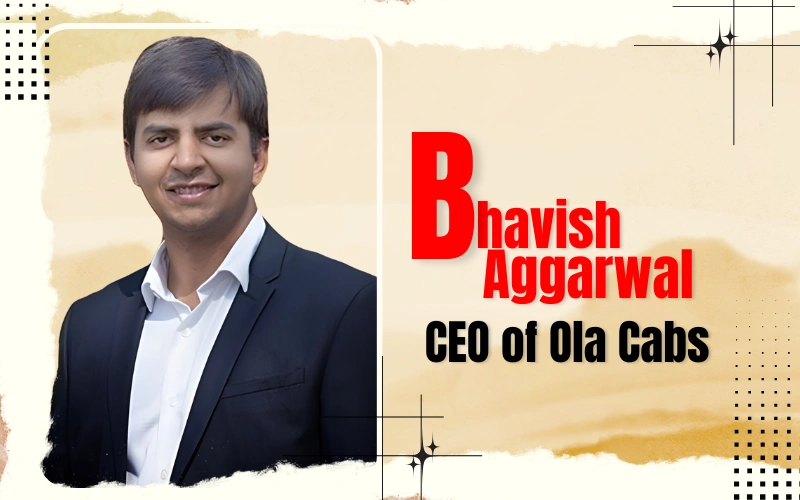
A young engineer stuck in traffic, frustrated with unreliable autorickshaws, decides he’s had enough. Fast forward a few years, and that same person is now challenging Elon Musk’s territory while revolutionizing how India moves. Meet Bhavish Aggarwal, the audacious entrepreneur who didn’t just build a cab-hailing empire—he’s literally building electric vehicles from scratch and taking on tech giants with homegrown AI.
Bhavish Aggarwal: Quick Stats at a Glance
| Category | Details |
|---|---|
| Full Name | Bhavish Aggarwal |
| Date of Birth | August 28, 1985 |
| Age | 39 years (as of 2025) |
| Birthplace | Ludhiana, Punjab, India |
| Education | B.Tech in Computer Science & Engineering, IIT Bombay (2008) |
| Notable Companies | Ola Cabs (Co-founder, 2010), Ola Electric (Founder, 2017), Krutrim AI (Founder, 2023) |
| Net Worth | Approximately $1.2 billion (2025 estimate) |
| Marital Status | Married to Rajalakshmi Aggarwal |
| Notable Achievements | TIME 100 Most Influential People (2018), Economic Times Entrepreneur of the Year (2016) |
| Current Role | Chairman & CEO of Ola Electric, Founder of Krutrim AI |
Physical Attributes
- Height: 5 feet 7 inches (170 cm)
- Weight: Approximately 75 kg
- Eye Color: Black
- Hair Color: Black
Hobbies and Interests
- Photography – Maintains a popular photoblog
- Cycling
- Playing Squash
- Reading – His favorite book is “The Lean Startup” by Eric Ries
- Traveling – Takes quarterly journeys to historical Indian sites (like Nalanda) to learn about India’s past and fuel his business vision
- Dog lover – Dogs have unbridled access to him in his office, meetings, and at home]
Achievements Timeline
- 2010: Co-founded Ola Cabs
- 2014: Featured in Forbes India 30 Under 30
- 2017: Won Economic Times Entrepreneur of the Year
- 2018: Named in TIME’s 100 Most Influential People
- 2021: Launched Ola S1 and S1 Pro electric scooters
- 2024: Founded Krutrim AI, India’s first AI unicorn
- 2024: Ola Electric went public with IPO
Early Life and Family Background
Bhavish Aggarwal was born on August 28, 1985, in Afghanistan, where his father was serving during the Soviet-Afghan war. His father, Dr. Naresh Kumar Aggarwal, is an orthopedic surgeon who courageously left India to treat those injured in the conflict. His mother, Dr. Usha Aggarwal, is a pathologist. He spent his childhood in the United Kingdom before his family returned to Ludhiana, India when he was ten years old.
Growing up in Ludhiana among industrialist families, Bhavish came from a middle-class background where education was highly valued. His parents, though doctors rather than businesspeople, never denied him resources for books and learning. He has two siblings: a brother, Ankush Aggarwal, who founded the online lending platform Avail Finance, and a sister named Arohi Aggarwal.
Education
Bhavish’s academic journey had an interesting start. He initially failed to crack the IIT entrance exam and went to Kota, Rajasthan to prepare for one year. His perseverance paid off when he secured rank 23 and gained admission to the prestigious Indian Institute of Technology (IIT) Bombay in 2004.
He graduated with a Bachelor of Technology degree in Computer Science and Engineering from IIT Bombay in 2008. During his time at IIT, he was actively involved in technical and entrepreneurial activities, co-authored research papers, and developed his passion for technology and innovation. Interestingly, in his class scrapbook, the young Bhavish had written a prescient line: “I want to make something for India in India.”
Early Career at Microsoft
Bhavish started his career with Microsoft Research India as a research intern in May 2007 for three months. After graduation in July 2008, he joined Microsoft as an Assistant Researcher, where he worked for just over two years. During this period, he filed two patents and published three papers in international academic journals.
While at Microsoft, he also ran a blog called desitech.in, which featured content about startups and technologies focused primarily on India, showcasing his early entrepreneurial interests.
Career Highlights and Major Achievements
The Birth of Ola Cabs (2010-2011)
The spark for Ola came from a frustrating personal experience. In 2010, when Bhavish rented a car for a weekend trip from Bengaluru to Bandipur with friends, the driver stopped in Mysore and demanded more money than initially agreed upon, forcing the group to complete the journey by bus.
Rather than simply complaining, the 23-year-old saw an opportunity to solve a widespread problem. After leaving Microsoft in July 2010, he initially started Olatrips.com, an online tour planning service. On December 3, 2010, he teamed up with his IIT classmate Ankit Bhati, and they pivoted to create an online cab aggregator in Mumbai for booking cars for outstation trips.
The early days were challenging. Without much working capital or investors backing them, they had to rely on their limited personal savings. The company was officially owned by ANI Technologies Pvt Ltd (which means “Hello” in Spanish). Their first round of angel investment came from Snapdeal founder Kunal Bahl, Rehan Yar Khan, and Anupam Mittal.
Growth and Expansion
By July 2014, Ola achieved its first major milestone of 10,000 rides per day. The company rapidly expanded across India and ventured into international markets including Australia, the UK, and New Zealand. Under Bhavish’s leadership, Ola launched multiple subsidiaries:
- Ola Fleet (January 2015)
- Ola Dash – grocery delivery service (July 2015, shut down June 2022)
- OlaMoney – mobile payments and wallet service (November 2015)
- Ola Cafe – food delivery (March 2015, shut down 2016)
- Ola Cars – car-selling platform (October 2021, shut down June 2022)
In December 2017, Ola acquired the Indian subsidiary of food delivery company Foodpanda. In April 2022, Bhavish stepped down from the day-to-day operations of Ola Cabs to focus on electric vehicles and quick-commerce. In August 2024, Ola Cabs was rebranded to Ola Consumer to offer a broader range of consumer services.
Ola Electric – The Electric Revolution
On May 26, 2017, Bhavish launched Ola Electric under ANI Technologies, starting with a pilot project in Nagpur, Maharashtra, setting up charging stations and procuring electric vehicles. Between December 2018 and January 2019, he purchased a 92.5% stake in Ola Electric for Rs. 92,500.
In January 2021, he acquired 500 acres of land in Pochampalli, Krishnagiri District, Tamil Nadu, to establish what would become the world’s largest electric two-wheeler manufacturing factory, named “Futurefactory.” In a bold and progressive move, he announced in September 2021 that the factory would employ only women, providing employment to over 10,000 women.
Ola Electric launched its first models, the Ola S1 and S1 Pro, in August 2021 (based on technology from Dutch company Etergo, acquired in May 2020). As of December 2022, Ola Electric sells three electric two-wheelers: Ola S1, Ola S1 Air, and Ola S1 Pro. The company had captured significant market share in India’s electric two-wheeler segment, though it has faced recent challenges with competition and service issues.
Ola Krutrim – India’s AI Ambition
In 2024, inspired by a visit from OpenAI’s Sam Altman who suggested India couldn’t build competitive AI, Bhavish launched Krutrim, a large language model AI company. His response was powerful: “He came to India and said, ‘Tumse na ho payega’ [You won’t be able to do it]. One day, we’ll go to the Bay Area and say, ‘Tumse na ho payega.'”
Krutrim became India’s first AI unicorn in 2024 with an estimated valuation of $1 billion. The company aims to build an entirely sovereign AI infrastructure, challenging tech giants like OpenAI in models, Nvidia in chips, and Microsoft in data centers.
The Accidental Entrepreneur: How a Bad Cab Ride Changed Everything
Let’s rewind to 2010. Bhavish Aggarwal had just wrapped up a stint at Microsoft Research as a research intern, and like any good Indian middle-class kid with an IIT degree, he was supposed to follow the well-trodden path: cushy job, fat paycheck, emigrate, repeat.
But fate had other plans—or rather, a rude cab driver did.
During a trip from Bangalore to Bandipur, Bhavish’s rented car driver abandoned him midway after a heated argument. Stranded on a highway with a patchy mobile network and zero options, something clicked. This wasn’t just his problem; this was India’s problem. The country had millions of cars, thousands of drivers, but zero reliable way to connect supply with demand.
Along with his IIT batchmate Ankit Bhati, Bhavish Aggarwal founded Ola Cabs in December 2010. The initial model? Simple. They aggregated existing cab services and gave customers a reliable booking platform. Think of it as the arranged marriage of transportation—matching riders with drivers through technology instead of desperately waving at passing autorickshaws.
David vs. Goliath: The Uber Battle That Defined a Decade
Here’s where things get spicy. When Uber entered India in 2013 with unlimited VC dollars and global swagger, most industry watchers wrote Ola’s obituary. After all, this was the company that had decimated local competitors in market after market worldwide.
But Bhavish Aggarwal didn’t just compete—he went to war.
While Uber focused on premium sedans for the elite, Bhavish doubled down on what made India unique. Ola launched Ola Auto (autorickshaw bookings), Ola Share (carpooling), and even Ola Micro (compact cars for budget-conscious riders). They understood that in India, affordability trumps luxury every single time.
The battle was brutal. Both companies burned billions in discounts and incentives. Driver poaching became an industry sport. Regulatory headwinds, safety concerns following high-profile incidents, and intense public scrutiny tested both platforms.
But by 2019, the verdict was clear: Ola commanded over 56% market share in India compared to Uber’s 32%, according to industry analysis. Bhavish Aggarwal had achieved something remarkable—he’d beaten a Silicon Valley giant on home turf, a feat that remains rare in global tech.
The Electric Dream: Building India’s Tesla (Sort Of)
If founding India’s largest ride-hailing platform wasn’t ambitious enough, Bhavish Aggarwal decided to manufacture electric vehicles from scratch. Because, you know, why not?
In 2017, Ola Electric was born with a mission that sounded borderline delusional: electrify India’s transportation and reduce dependence on fossil fuels. Remember, this was when most Indians hadn’t even seen an electric scooter, let alone considered buying one.
Fast forward to 2025, and Ola Electric operates the world’s largest women-only manufacturing facility—the Ola Futurefactory in Tamil Nadu. Spread across 500 acres with a potential annual capacity of 10 million units, this facility is Bhavish’s middle finger to critics who said Indian companies can’t manufacture at scale.
The Ola S1 series of electric scooters, launched in 2021, disrupted the two-wheeler market with aggressive pricing, impressive range, and tech features that made traditional scooters look like relics from the Stone Age. By 2024, Ola Electric had captured over 30% of India’s electric two-wheeler market share.
Krutrim: Taking on ChatGPT with ‘Indian’ AI
Just when you thought Bhavish Aggarwal might take a breather, he launched Krutrim AI in 2023—India’s answer to ChatGPT and other global AI models.
Krutrim (which means “artificial” in Sanskrit) is built on the premise that India needs AI trained on Indian languages, cultural context, and local knowledge. While ChatGPT might nail Shakespearean sonnets, it often fumbles when you ask it about Kabir’s dohas or regional festival traditions.
Within months of its launch, Krutrim became India’s first AI unicorn, achieving a $1 billion valuation in January 2024. The model supports over 20 Indian languages and claims to understand Indic context better than foreign alternatives.
The Controversies: When Ambition Meets Criticism
Let’s address the elephant in the room—Bhavish Aggarwal is no stranger to controversy, and 2024-25 has been particularly spicy.
The Comedian Clash
In October 2024, stand-up comedian Kunal Kamra tweeted about poor customer service experiences with Ola Electric scooters, sharing images of numerous scooters piled up at service centers. What followed was a very public Twitter spat where Bhavish personally responded, inviting Kamra to contribute rather than criticize, and asking if he was “paid” to post negative content.
The internet did what the internet does best—picked sides, created memes, and turned a customer service issue into a national debate about founder accountability and corporate arrogance.
The Quality Control Questions
Multiple customers have reported issues ranging from software glitches to mechanical failures with Ola Electric scooters. Service center backlogs became viral content. The Central Consumer Protection Authority even issued notices seeking explanations for consumer complaints.
To his credit, Bhavish Aggarwal didn’t hide. He acknowledged the challenges, announced expansive service network plans, and committed to improving quality control. Whether these promises translate to ground reality remains to be seen.
The Work Culture Debate
Former employees have occasionally spoken about the high-pressure work environment at Ola and its sister companies. The “move fast and break things” culture that fuels innovation can also lead to burnout—a tension every scaling startup faces.
The Leadership Philosophy: Move Fast, Think Big, Stay Indian
What makes Bhavish Aggarwal tick? Based on his interviews, public statements, and business decisions, a few patterns emerge:
1. Unshakeable Self-Belief
When everyone said competing with Uber was suicide, Bhavish doubled down. When advisors questioned the wisdom of manufacturing hardware, he built the world’s largest two-wheeler factory. This isn’t recklessness—it’s calculated conviction.
2. Long-Term Thinking
Ola burned cash for years before achieving profitability. Ola Electric is still in investment mode. Krutrim is a multi-year bet. Bhavish plays the long game while most Indian founders optimize for the next funding round.
3. Building for India, By India
From hiring practices to product design, there’s a deliberate focus on Indian talent, Indian manufacturing, and Indian consumers. This isn’t just nationalism—it’s smart business in a market of 1.4 billion people.
4. Vertical Integration
Why own just the platform when you can own the entire stack? Ola controls the ride-hailing app, manufactures vehicles, develops battery technology, and builds AI models. This vertical integration is rare in the Indian startup ecosystem and speaks to Bhavish’s Amazon-esque ambitions.
The Broader Impact: Beyond Business Metrics
Bhavish Aggarwal’s influence extends far beyond revenue numbers and market share:
Job Creation: Ola’s ecosystem—including drivers, support staff, manufacturing employees, and supply chain partners—supports millions of livelihoods. The Ola Futurefactory alone employs over 10,000 people, predominantly women.
EV Adoption: Love or hate the execution, Ola Electric accelerated India’s electric vehicle conversation by years. They made EVs aspirational and affordable for the middle class.
Entrepreneurial Inspiration: A generation of Indian founders now believes that competing with global giants is possible. Bhavish proved you don’t need to emigrate to build world-class companies.
Technology Self-Reliance: With Krutrim and other initiatives, there’s a growing emphasis on indigenous technology development—crucial for a country that aspires to be a global superpower.
What’s Next? The 2025 Roadmap and Beyond
As of early 2025, Bhavish Aggarwal is juggling multiple moonshots:
- Ola Electric’s Car Launch: The much-anticipated electric car is expected to debut later this year, directly competing with Tata Motors and international brands.
- Scaling Krutrim: Plans to integrate Krutrim AI across Ola’s ecosystem while offering it as an enterprise solution.
- International Expansion: Ola Electric has hinted at exports to European and Latin American markets.
- Improving Service Infrastructure: Addressing the elephant in the room with massive service center expansion.
Conclusion: The Unfinished Symphony
Bhavish Aggarwal is many things—visionary, controversial, ambitious, polarizing. But above all, he’s undeniably consequential. Whether he’s revolutionizing urban mobility, accelerating EV adoption, or building foundational AI, his impact on India’s business landscape is profound and enduring.
Is he perfect? Far from it. Has he made mistakes? Plenty. Will every bet pay off? Unlikely. But here’s what matters: Bhavish Aggarwal dared to compete when others chose comfort. He built when others consulted. He stayed when others left.
Frequently Asked Questions (FAQs)
1. What is Bhavish Aggarwal’s current net worth?
As of 2025, Bhavish Aggarwal’s net worth is estimated at approximately $1.2 billion, primarily derived from his stakes in Ola Cabs, Ola Electric, and Krutrim AI. However, net worth fluctuates based on private valuations and public market performance.
2. How did Bhavish Aggarwal start Ola?
Bhavish Aggarwal co-founded Ola Cabs in 2010 with IIT Bombay classmate Ankit Bhati after a frustrating experience with an unreliable rental car driver. The initial concept was to aggregate existing taxi services and provide customers with reliable, technology-enabled bookings.
3. What are the main controversies surrounding Bhavish Aggarwal?
Recent controversies include public disputes over Ola Electric’s customer service quality, a social media clash with comedian Kunal Kamra, regulatory notices regarding consumer complaints, and criticisms about the work culture at his companies. Bhavish has been both criticized for being defensive and praised for directly engaging with feedback.
4. What is Krutrim AI, and why did Bhavish Aggarwal create it?
Krutrim AI is India’s first AI unicorn, founded by Bhavish Aggarwal in 2023 to create AI models trained on Indian languages, cultural context, and local knowledge. The goal is to reduce dependence on foreign AI platforms and build indigenous AI infrastructure for India’s digital future.
5. Is Ola Electric profitable?
As of early 2025, Ola Electric is still in aggressive investment mode, focusing on scaling manufacturing, expanding service networks, and developing new products. Like many growth-stage companies, profitability is being prioritized after achieving scale and market dominance.
Rishad Premji: 7 Powerful Leadership Lessons from Wipro’s Transformative Chairman
